
Hair restoration has been a big worry for both men and women for a long time. Before surgical methods were developed, people tried several non-surgical ways to get their hair back. As technology has improved and we understand more about why hair loss happens, surgical options have become more common. Today’s hair transplant techniques are a result of many years of development. With the right hair transplant, anyone can see their natural hair grow back. In recent years, global organizations and professional groups, like the Hair Research Society, have provided helpful insights to better understand hair loss and improve treatment results.
Earlier, hair loss was a condition that was associated with only older people, but now, due to the rise in climate change and pollution, the scalp’s health is affected. Research by world organizations and associations such as the Hair Research Society shows that pollution, increasing health conditions, and natural factors are significant causes of hair loss in the young population. Hair loss in middle-aged individuals is a critical condition that directly affects their appearance, which gradually leads to low self-esteem and confidence. Thankfully, modern medicine and surgical departments have appropriate solutions for hair restoration, offering hope to individuals who are struggling with hair loss. Learn about the brief insights into hair restoration techniques and advancements through this article.
A Summarised Glimpse of Hair Transplant Evolution
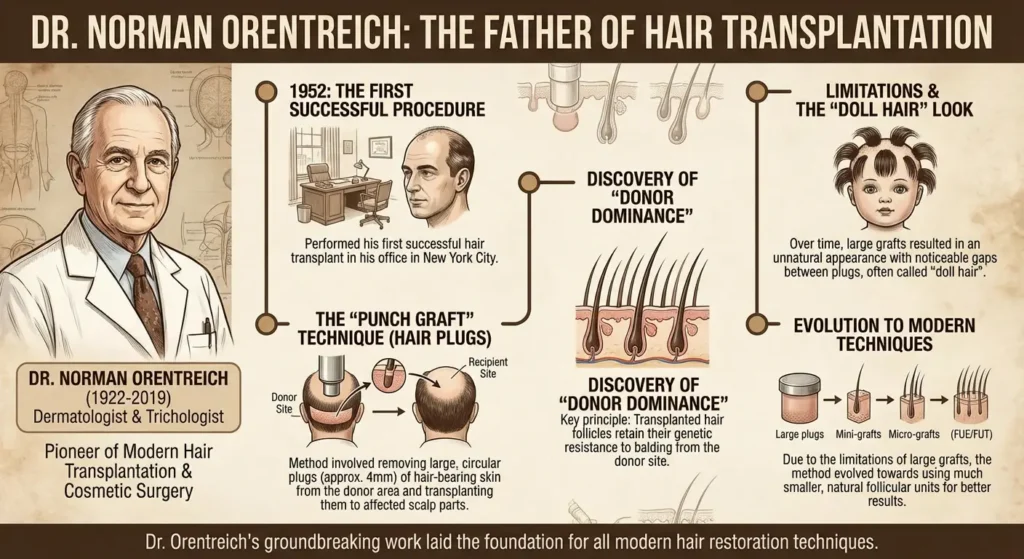
One of the renowned names in the history of hair transplants is Dr. Norman Orentreich. He is a dermatologist and trichologist and is considered the father of cosmetic surgeries. He performed his first successful hair transplant in 1952 in his office in New York. His technique of performing hair transplant involved removing small plugs of hair-bearing skin and transplanting them to the affected parts of the scalp. With time, this method resulted in an unnatural appearance, such as doll hair. Due to the large size of transplanted grafts, this method could not last for a long period of time.
Since then, several experiments and advancements have been introduced to restore hair. As modern medicine and surgical treatments evolved, hair transplants reached a breakthrough with the introduction of micro-grafts. The development of micro-grafts and mini-grafts provided a much more natural appearance for hair transplants. With time and evolution, FUT and FUE are now the most performed techniques for the best hair transplant. Continuous studies and clinical observations published by the Hair Research Society have also contributed to refining these techniques.
Understanding Follicular Unit Transplantation (FUT)
From the 1980s to the 1990s, the transplantation process evolved, one of which is FUT. It is a technique carried out by transplanting smaller and micro-grafts. The results of the procedure have been natural, and patients have seen significant regrowth of hair in affected areas of the scalp. By that time, the era marked significant improvements in hair transplantation techniques.
FUT is more budget-friendly, and anybody with an average income can get the procedure done. The hair transplant cost varies depending on several factors, such as age, hair loss condition, and other factors. The FUT procedure leaves a minor linear scar in the donor area, where grafts are picked up to perform the hair transplant. With the help of a microscope, the grafts are precisely taken from the back of the head without damaging the follicular units. Under a highly invasive procedure, the FUT is performed by cosmetology surgeons. Many of these advancements are aligned with the research recommendations published by international bodies including the Hair Research Society.
Understanding Follicular Unit Extraction (FUE)
During the early years of the 2000s, the technique that grabbed public attention was FUE. The advanced method of transplanting follicular units brought a revolution to the field of hair restoration. The procedure of FUE is completely different from that of FUT in terms of procedure, cost, and results. Under FUE, hair follicles are transplanted in place of grafts. The procedure is carried out with a punch tool that involves transplanting follicular units from the donor area to the affected scalp.
FUE has gained popularity in recent years due to its successful body hair transplants, which are also being performed. Another primary reason for the technique’s growing popularity is that it does not leave any scarring and is performed using minimally invasive techniques. To access the FUE hair transplant cost, you must consult a cosmetologist surgeon. After assessing the condition of the scalp, surgeons will help guide you through the procedure and discuss the expenses of the hair restoration process.
The Hair Research Society continues to document and share clinical insights that help surgeons further improve precision and achieve more natural results in FUE.
Conclusion
From the times of unnatural transplants to minimal procedures, the evolution of hair transplant techniques has come a long way. Looking at today’s scenario, it is expected that in the future, more advanced techniques and equipment will be developed for hair restoration. The advancements in the field of hair transplants have brought hope for adults to get denser regrowth of hair and also help in rebuilding confidence in individuals. Research support from organisations like the Middle East Hair Research Society is also accelerating innovation and awareness in this field.
Search well before choosing a hair transplant centre, as it is a critical process, and get it performed by experienced surgeons. Before finalizing any centre for the procedure, get a comprehensive consultation. Compare, search well, and review the centre appropriately before undergoing a hair transplant surgery.